

"WAC accounts are going away, so we can just buy everything on GPO and 340B?!"
That's the take Jason Mills heard from customers within hours of a federal court vacating part of HRSA's 340B guidance in March. On QuicksortRx’s IGQ (I Got Questions), Jason sat down with longtime friend and QuicksortRx’s Pharmacy Account Specialist, Kyle Lenio, PharmD, to walk through why that read doesn't hold up — and what the ruling actually changed for hospital pharmacy purchasing.
Don’t have 35 min to check out the full episode? Here are the key takeaways:
Episode Highlights Worth Knowing
- The GPO prohibition is still the law. The court ruling only vacated the guidance on that first WAC purchase — not the prohibition itself.
- Hospitals now have a choice on that first purchase. But if your accumulation model is dialed in, it was never the real problem.
- WAC premium spikes come from predictable sources: poor accumulation, weak scan compliance, and — the biggest one — drug shortage buys.
- GPOs have a stake in this too. They don't get volume credit for WAC purchases, so this ruling benefits them as much as it does hospitals.
- The real fix would be a negotiated ramp-up period — a temporary sub-WAC price when switching to a new manufacturer's NDC.
Here's What the Court Case Actually Decided
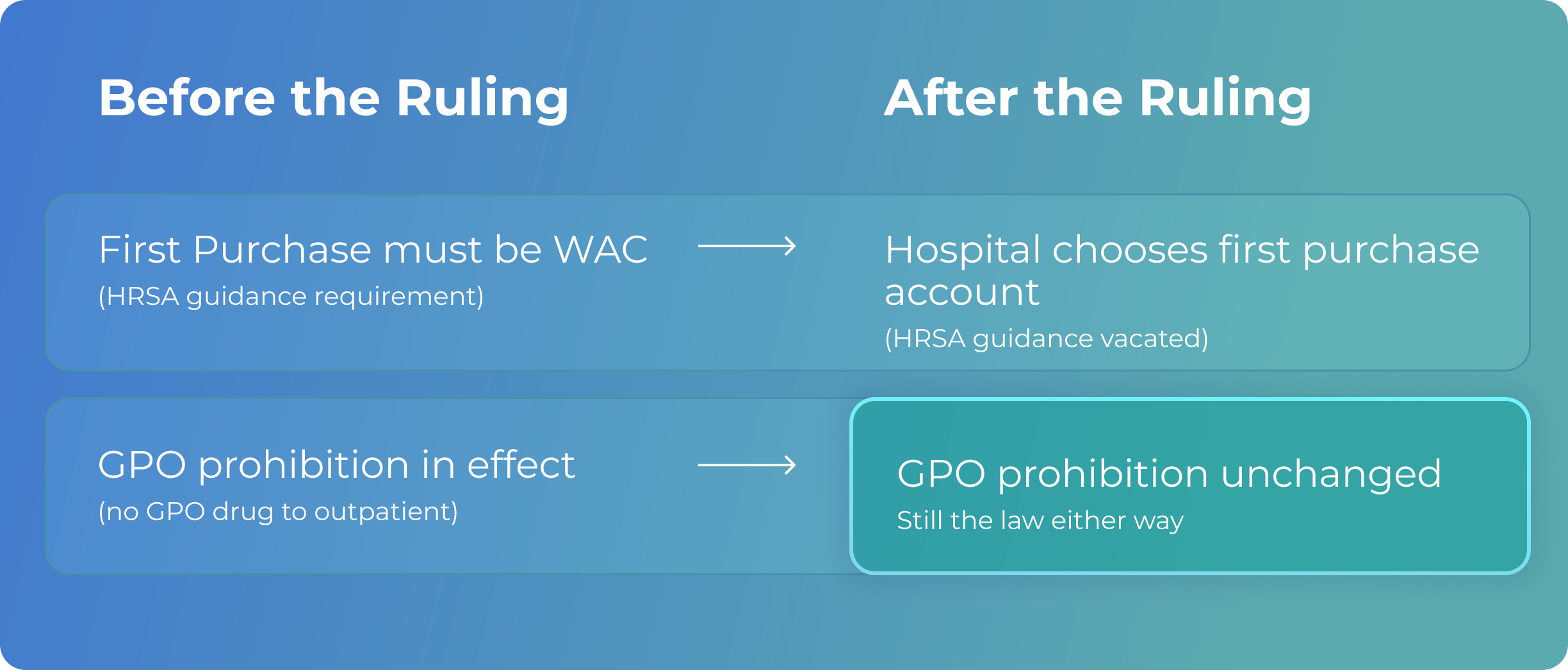
Episode two of IGQ had Jason and Kyle unpacking the 340B GPO prohibition ruling, decided at the end of March, which challenged HRSA's long-standing guidance on how covered entities should handle their first purchase of a given NDC under a replenishment model. HRSA's original 2013 guidance instructed hospitals to make that initial purchase on WAC, since the buyer doesn't yet know whether the drug will go to an inpatient or an outpatient. That neutral purchase is what "earns" the accumulation credit that lets the next unit on the shelf go to either type of patient.
The plaintiffs didn't argue that hospitals should be allowed to buy on GPO or 340B in violation of the prohibition. They argued that HRSA's guidance — not the statute — was costing hospitals millions of dollars in aggregate, since WAC is typically the highest of the three price points. The court agreed on the narrow point: the choice of account for that first purchase belongs to the hospital, not to HRSA's guidance.
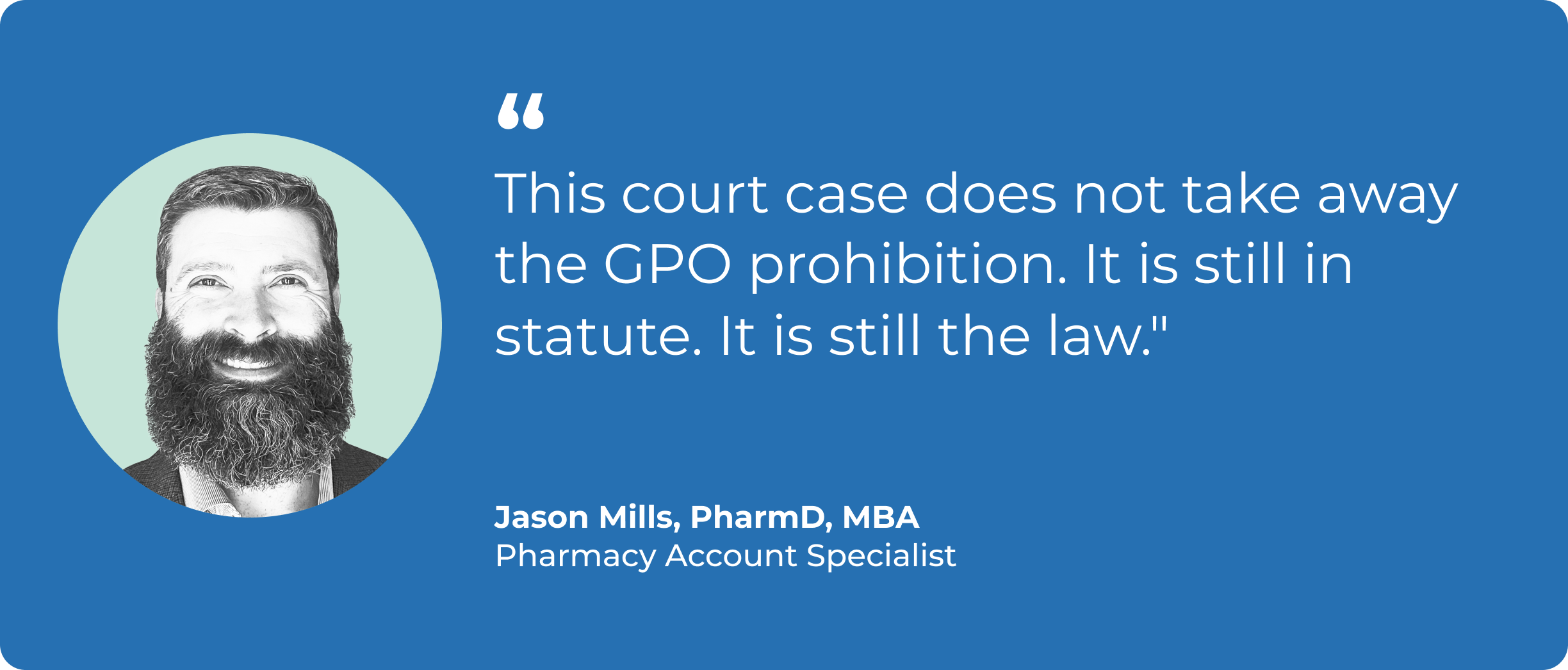
What didn't change: the GPO prohibition itself. A hospital still cannot administer a GPO-purchased drug to an outpatient. That rule is written into statute, and this ruling left it fully intact. It's a clarification Jason pointed out numerous times throughout the episode.
Why WAC Accounts Aren't Going Anywhere
In terms of customer reactions, Jason and Kyle recapped what QuicksortRx started hearing almost immediately: WAC accounts are done, hospitals can just buy everything on GPO and 340B going forward. Both pushed back on that read due to how replenishment models actually work.
Most replenishment models rely on the neutral WAC purchase specifically because a buyer can't always know, at the moment of that first purchase, where the drug is ultimately headed. The alternative — a fully segregated physical inventory split between inpatient and outpatient stock — creates its own operational burden that most pharmacies aren't equipped to run.
The practical reality: If your accumulation software is working well, that first WAC purchase is an upfront cost, not an ongoing drag. The ruling gives hospitals permission to route that first purchase differently. It doesn't remove the need for a neutral starting point in most replenishment workflows.
Where WAC Premium Actually Comes From
If WAC isn't the disaster the headlines made it out to be, where does WAC premium actually come from? Kyle breaks it down to a short, specific list:
- Products that don't accumulate cleanly — think insulins and other high-waste categories where administration doesn't map neatly back to a single unit.
- Drugs administered in areas with weak scan compliance, where the correct NDC doesn't always get captured at 100%.
- Drug shortage purchases, where a product with a strong GPO price and a poor WAC price still has to be bought on WAC because it's the only option available at the time.
Shortage buys were the example Kyle came back to more than once: A hospital that has to buy a high volume of a short drug at WAC pricing can eat a significant one-time cost that's difficult to reclass after the fact. He pointed to real spikes his team sees regularly in customer data — a single shortage event running $100,000 in WAC premium that rarely gets revisited once the drug is back in stock.
Why GPOs Have a Stake in This Ruling Too
In the episode, Jason raises a point that's easy to miss in the coverage: GPOs don't receive volume credit for purchases made on WAC. That means a policy shift that pushes more first-purchases toward GPO accounts serves GPO contract utilization directly, not just hospital cost savings.
That doesn't make the ruling self-serving on its own, but it explains why a GPO was among the parties bringing the case.
The framing matters: A change presented as a hospital cost-savings win can also be a GPO volume-capture win, and the two aren't mutually exclusive.
The More Useful Fix: A Negotiated Ramp-Up Period
The most concrete idea in episode two wasn't about the lawsuit at all. Jason and Kyle discussed what could happen if manufacturers and GPOs worked something out voluntarily when a hospital switches to a new contracted NDC. Instead of hospitals absorbing a high WAC price for weeks while accumulation builds, a temporary sub-WAC pricing window — effectively bringing WAC close to the new GPO contract price for an introductory period — would blunt the overage without touching the prohibition at all.
That kind of arrangement would benefit hospitals, GPOs, and manufacturers alike: Hospitals avoid the upfront hit, GPOs get faster contract adoption, and manufacturers avoid a wave of reclassification requests months later.
.png?width=610&height=732&name=Jasons%20Image%20(1).png)
Jason and Kyle both call this ruling a “nothing burger” on first blush — and agree that a month of hindsight hasn't added any more meat to it.
What This Means for Hospital Pharmacy Teams Today
The GPO prohibition is unchanged. Don't administer a GPO-purchased drug to an outpatient. That rule isn't going anywhere.
You now have more discretion on that first purchase, but for most well-run programs, the operational upside is modest.
Shortage purchases remain the biggest lever for WAC premium reduction. That's where audit attention pays off fastest.
Watch for negotiated ramp-up terms on new NDC switches — that's a more realistic savings opportunity than betting on further changes to the prohibition itself.
Turn This News Into an Action Plan for Your Pharmacy
QuicksortRx helps pharmacy teams identify which purchases are driving WAC premium — whether it's a shortage buy, a scan-compliance gap, or a product that consistently accumulates poorly — so you know where to focus before the next audit cycle.
Request a demo to see what your purchasing data actually shows, and watch the full IGQ Episode 2 for the complete conversation.