

Episode one of IGQ (I Got Questions) didn’t waste any time diving into one of the most consequential — and most misunderstood — metrics in the pharmacy supply chain: COGS (cost of goods sold). Jason Mills was joined by QuicksortRx’s Dr. Rober Rose to help pull back the curtain on how wholesaler agreements actually work, why modern COGS structures have gotten dramatically more complex, and what pharmacy directors should be auditing today.
If you can’t watch the full episode on YouTube, here’s what you need to know.
Episode Highlights Worth Knowing
- COGS is a discount, not just an accounting calculation— and most finance-trained leaders don't realize that until they're already in the chair.
- The flat universal COGS rate is gone. Modern agreements can have anywhere from four to seven distinct rate tier “buckets” depending on account type, drug category, and purchasing channel.
- How fast you pay your wholesaler directly affects your COGS rate — but committing to aggressive payment terms without finance alignment is a fast way to blow the savings you just negotiated.
- Emergency "hot shot" orders typically don't qualify for your contracted COGS discount, and many buyers have no idea there's a price difference until someone goes looking.
- When you audit your COGS and find a discrepancy, it's usually a big one — which is exactly why quarterly audits should be a standing KPI, not a one-time exercise.
What COGS Actually Means in Hospital Pharmacy
In a traditional accounting context, the cost of goods sold is a simple calculation. In hospital pharmacy, COGS often refers to the discount a wholesaler applies to drug purchases. The price a buyer sees in the portal usually reflects that percentage reduction.
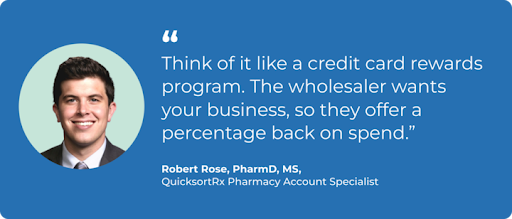
The credit card analogy holds in more ways than one. Just like credit card rewards have gotten more tiered and conditional — 5% cash back on groceries, 4% on gas, 2% on all purchases, etc. — so too have wholesale agreements.
The Flat Fee Discount Era is Gone
Years ago, COGS was often one flat discount across your entire drug spend applied uniformly.
That model is largely gone. We have seen wholesaler agreements now segmenting COGS by account type (WAC, 340B, GPO), by medication category (standard, specialty), and sometimes by whether a drug was purchased under an inpatient or outpatient account. On the episode, Dr. Rose noted seeing agreements with anywhere from four to seven distinct COGS "buckets" — and that's not an outlier, that's becoming the norm.
What this means in practice: The same drug, purchased at the same pharmacy, can carry a different COGS rate depending on which account it was purchased under. That's a level of complexity that didn't exist a decade ago, and most teams haven't fully caught up to it.
Why Payment Terms Belong in Your Negotiation Strategy
One of the more practical segments of the episode covered payment terms. The faster you pay your wholesaler, the better your COGS rate — and that spread can be meaningful.
Jason shared an example from his time managing a pharmacy supply chain: It wasn’t until he had executed his first agreement and was up for second renewal that he was presented with a chart that outlined payment terms discounts, e.g., paying 7 days after invoice could yield a meaningfully better COGS than paying at net 45. The dollar difference, when applied across a large health system's drug spend, adds up fast.
The catch?
Executing on aggressive payment terms is harder than signing up for them. Getting finance aligned, clearing multi-million-dollar invoices through approval workflows, and consistently hitting shorter windows requires operational discipline across departments that often aren't in the same room when the distribution agreement gets signed.
Lesson from the episode: Model the payment term you can actually execute, not just the one with the best COGS number.
The Fine Print on “Hot Shots” Most Buyers Don’t Know
This section of the episode was one of the more eye-opening moments. In most wholesaler agreements, emergency or expedited orders, called "hot shots", don 't carry the same COGS discount as standard orders. That means when a buyer places an urgent order to get a medication before the next scheduled delivery, they may be paying full WAC (or close to it) rather than the discounted rate.
To illustrate the point, Jason discussed a real example with Dr. Rose about an NDC that showed two different price points for the same drug within a three-month window — no contract change, no price increase. When the team dug in, they found the discrepancy traced back to a drop-ship emergency order. The buyers had no idea there was a pricing difference; they just saw "the price."
This is exactly the kind of thing that doesn't get caught unless someone is looking for it.
The Case for Quarterly COGS Audits
Episode one closed on an important operational note: Most pharmacy teams aren't auditing their COGS with any real regularity — and given how much complexity has been layered into modern agreements, that gap matters.
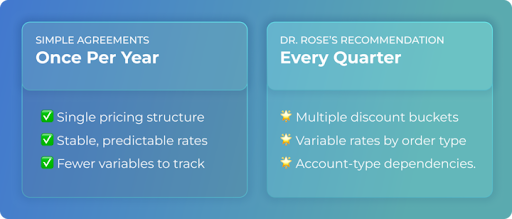
Dr. Rose's recommendation:
For older, simpler agreements, once per year is reasonable.
For modern agreements with multiple buckets, variable rates, and account-type dependencies, quarterly is the right cadence.
And it's not just about confirming the right rate is being applied, it's about catching reclassification issues, flagging drugs that have landed in the wrong bucket, and identifying where your actual COGS rate diverges from what your agreement says it should be.
The upside when you do find something? It tends to be significant. A small percentage off a large number is still a large number, and depending on how long a discrepancy has existed, the credit potential can be substantial.
Dr. Rose also noted that resolving discrepancies requires collaboration. Start with your wholesaler rep, escalate if needed, bring finance in early, and document everything. Wholesalers are bound by the signed agreement and will work to make it right, but the reconciliation process can be complex, especially if it involves reclassifying purchases across quarters with different COGS rates.
The Takeaway for Leadership
With modern agreements introducing multiple rate tiers, account-type dependencies, payment term variables, and specialty carve-outs, the margin for misalignment has grown considerably. Health systems that treat COGS as a one-time negotiation deliverable rather than an ongoing KPI are leaving money on the table.
If you have the time, the first episode of IGQ is worth the full listen. And if you're managing a distribution agreement renewal in the next 12 months, we’d say it’s essential.
Want to Know What Your COGS Rate Should Be?
QuicksortRx helps pharmacy teams get visibility into where their purchasing data diverges from their contracted terms — so discrepancies don't go undetected for quarters at a time.
Request a demo to see what your data actually shows.